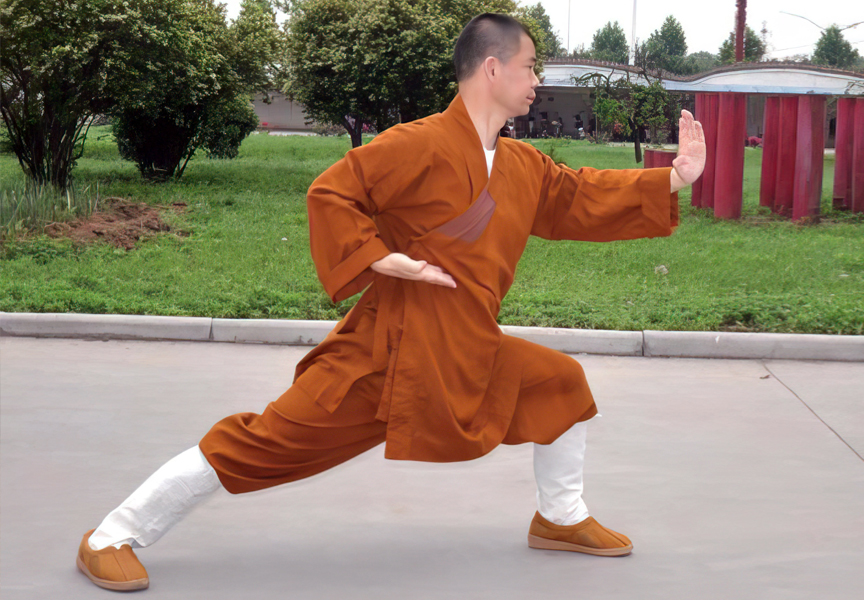
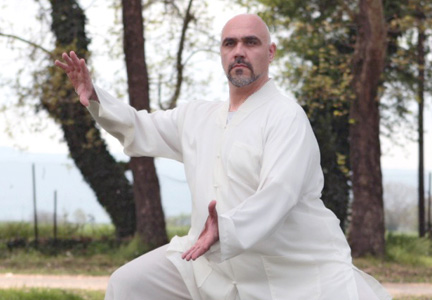
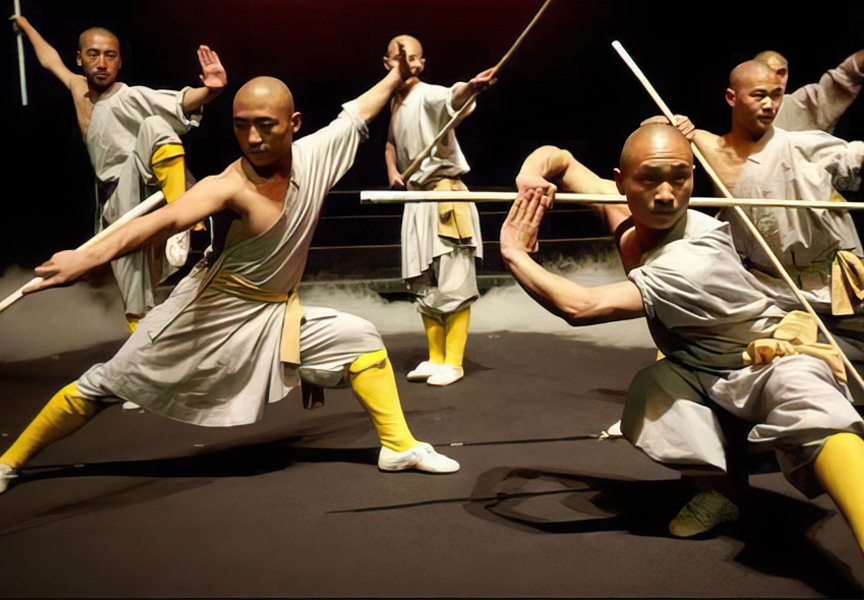
Soft Fist - Rou Quan [Chin.: róuquán 柔拳], is an excellent Shaolin Internal Exercise «Nei Gong» [Chin.: Shàolín nèigōng 少林 內功], which constantly develops human body’s physical and vital energy reserves and in conjunction with the «Five Skills» [Chin.: wǔgōng 五工], allows strides of improvement to anyone who wants to evolve his skills in concentration, balance and deep relaxation. Shaolin Rou Quan addresses to all ages and can be adapted to individual’s specific features and sensibilities, while improving them.
By the term «Soft» - «Rou» is meant supple and pliable, not flabby and loose and therefore can be used as an ideal method for physical rehabilitation and serious injuries treatment as well as performance improvement on athletes or trainees in other similar activities. Shaolin Rou Quan and all sets of internal exercises deriving from it, have many qualities, concepts, movements, techniques and postures, similar to those we find in Tai Ji Quan [Chin.: tàijí quán 太极拳], which historically was developed much much later.
«soft subdues hard»
[Chin.: róu shèng gāng 柔胜刚]
Monk Xuanji [Chin.: xuánjī héshàng 玄機和尚] Shaolin stele 1631 CE
Shaolin Rou Quan is part of one of of the longest running oral traditions in Shaolin, called «Chan Qi Jian» [Chin.: Shàolín chǎnqìjiàn 少林 产 气 健] which together with the «6 harmonic exercises» - Liu He Gong [Chin.: liùhé gōng 六合功], the «Circular Exercises of Chan» - Chan Yuan Gong [Chin.: chán yuán gōng 禅圆功] and the «Luohan Vital Energy Exercises» - Luo Han Qigong [Chin.: luóhàn qìgōng 罗汉 气功], composed the basic daily practice in Shaolin’s «South Garden» or «South courtyard» [Chin.: shàolín nányuàn 少林 南院], the famous «Zhou Fu An» [Chin.: zhōufǔān 周府庵], the residence of the senior and retired Shaolin monks [Chin.: lǎo sēng 老僧]. They were practicing Rou Quan, as its soothing and soft motions are considered excellent for older marital artists wishing to retain their skills.
Chan’s early «Treatment Exercises» [Chin.: chányī 禅医], were also based on Shaolin Rou Quan.
History
According to Shaolin oral tradition, Rou Quan was created by Hui Ke, the second Patriarch [Chin.: èrzǔ huìkě 二祖慧可], who completed his knowledge inherited by Bodhidharma [Chin.: pútí dámó 菩提達磨] with his own personal experiences and knowledge -he was a former military officer before he became a monk- in order to heal and overcome his arm amputation. Shaolin Ancestor, had been practicing on a plateau, later called the «Arm Healing Terrace» [Chin.: yǎngbì tái 养臂 台], where today are lying the ruins of the «Temple of Second Patriarch» [Chin.: èrzǔ ān 二祖庵].
During the turbulent transition period from Ming to Qing dynasty, Soft Fist and Chan Qi Jian in general, passed out of the Shaolin temple walls. Liable for that, was a Ming general, Chen Wan Ting [Chin.: chén wángtíng 陈王廷 | 1600 ~ 1680 CE] of Chen village [Chin.: Chén jiāgōu 陳家溝]. Chen Wan Ting often visited the South Garden and practiced Shaolin Chan Qi Jian [Chin.: Shàolín chǎnqìjiàn 少林 产 气 健] as well as Shaolin Xu Zhuang [Chin.: shàolín xūzhuāng 少林 虛桩], so he had the opportunity to inspect the Shaolin manuals and incorporate them to his techniques, thus creating a style, known today as Chen Tai Ji Quan [Chin.: chénshì tàijíquán 陳氏 太極拳].
For about two centuries, the technique was held inside Chen family, while the 6th descendant of the General, Chen Zhang Xing [Chin.: chén zhǎng xìng 陈长兴 | 1771 ~ 1853], taught Rou Quan to the 13 year old Yang Lu Chan [Chin.: yánglùchán 杨露禅 | 1799 ~ 1872 ], who became famous for his «Soft Hands» [Chin.: ruǎn shǒu 软手].
Two nearly identical books from the Qing dynasty period on Shaolin martial arts were the «Hand Combat Classic, Collection of Hand Combat Methods» [Chin.: quán jīng quánfǎ bèi yào 拳经 拳法备要], by Cao Huandau [Chin.: cáohuàndòu 曹煥斗], written in 1784 CE and «Xuanji's Secret Transmission of Acupuncture Points Hand Combat Formulas» [Chin.: xuánjī mìshòu xuédào quánjué 玄机 秘授 穴道拳诀] by Zhang Minge [Chin.: zhāng míngè 张鸣鹗]. In his preface Cao Huandau mentions that it is an annotated version of a century earlier book written by Zhang Kongzhao [Chin.: zhāng kǒngzhāo 张孔昭], who studied that Shaolin method with Zhang Minge, who is given as author of the preface of the second book. Both books attribute these fighting methods to a monk named Xuanji [Chin.: xuánjī héshàng 玄機和尚], who is mentioned on a Shaolin stele since 1631 CE. In these books, this Shaolin martial art is described in much the same terms as the modern Tai Ji Quan.
Those manuals describe fundamental techniques for stepping [Chin.: bù 步], throwing [Chin.: diē 跌 die], seizing [Chin.: ná 拿], throwing off balance by hooking the opponent's legs [Chin.: guān 关] and acupuncture or pressure point strikes [Chin.: dǎ xué 打穴]. Finally, the manuals show that internal strength, neigong [Chin.: nèigōng 內功], was the driving energy for the combat aspects of the fighting method, and the combat movements were done to cultivate Qi [Chin.: qì 气].
Worth mentioning is the significant improvement to Shaolin Rou Quan, during Qing Dynasty [Chin.: Qíngdài 清代 | 1644 ~ 1911 C.E.], by the legendary monk Shi Zhan Ju [Chin.: Shì Zhànjǔ 释 湛 举 | 1776 ~ 1865 CE], student of monk Shi Hai Can [Chin.: Shì Hǎicān 释 海参]. Zhan Ju was a great therapist [Chin.: yīsēng 医 僧], an expert in Shaolin Medicine and Shaolin Temple’s Martial Arts [Chin.: Shàolínwǔgōng 少林 武功].
Designation
According to the verbal transmission of the Shaolin masters lineage, Soft Fist was called many names. The most prominent were «Conquering the Gate of Chan [Chin.: chánmén gōng 禅门功] or «Conquering the Gate of Enlightenment» [Chin.: Fóméngōng 佛门功], having always in mind that Shaolin are primarily buddhist monks.
Outside the Temple walls, Rou Quan was called, Sort Strike [Chin.: duǎndǎ 短打], Cotton Palm [Chin.: mián zhǎng 棉掌], Soft Hands [Chin.: ruǎn shǒu 软手], or was called after the family or the clan, practicing the particular family skill, like Yue family [Chin.: yuèjiā 岳家], Ren family [Chin.: rèn jiā 任家], Liu family [Chin.: liú jiā 刘家] or Chen family [Chin.: 陳氏], Yang family [Chin.: yáng shì 楊氏], Wu family [Chin.: wǔ shì 武氏] etc.
The term Tai Ji Quan, emerged on the first half of the 19th century, during the reign of the Qing Emperor Daoguang [Chin.: dàoguāng dì 道光帝 | 1820 ~ 1850], while the earliest cogent text, in a manual of 1880, «Short Preface to Tai Ji Quan» by Li Yiyu [Chin.: lǐyìyú 李亦畬 | 1832 ~ 1892], nephew of Wu Yuxiang [Chin.: wǔyǔxiāng 武禹襄 | 1812 ~ 1880]. Wu Yuxiang was Yang’s disciple and founder of his own school of Tai Ji Quan [Chin.: wǔ shì 武氏] or Hao [Chin.: hǎo shì 郝氏].
Unfortunately, most of Shaolin historic and cultural materials, were in fact destroyed during the turbulence of modern Chinese history, thus given open free space to the modern Tai Ji Quan, consolidating its presence to Westerners and flourish without a rival. As a result, in 1946, Zheng Manqing [Chin.: zhèng mànqīng 郑曼青 | 1902 ~ 1975], a 4th generation of Yang family disciple, developed a significantly abbreviated 37 move version of Yang's traditional form.
In 1956, the Chinese Sports Committee, assigned to four Tai Ji Teachers -Chu Guiting [Chin.: chǔ guìtíng 褚桂亭 | 1892 ~ 1977], Cai Longyun [Chin.: cài lóngyún 蔡龙云 | 1928 ~ ], Fu Zhongwen [Chin.: fù zhǒngwén 傅踵文 | 1903 ~ 1994], and Zhang Yu [Chin.: zhāng yù 张玉 | 1909 ~ 1988]- to create a simplified form of Tai Ji as exercise for the masses, which was avidly promoted by the People's Republic of China. Due to this official promotion, the 24 postures form is the form with the most practitioners not only in China but all over the world. Today, scattered pieces of Rou Quan constitute so many styles that they can scarcely be counted.
But strict to Shaolin tradition, the courageous Shaolin monk of the 50’s, Shi De Gen [Chin.: shì dé gēn 释德根 | 1914 ~ 1968], founder of Shaolin temple’s «Shaolin Middle School» [Chin.: Shàolín zhōngxué 少林中学], called this ancient internal art, the Soft Cultivation of Shaolin, Shaolin Rou Gong [Chin.: Shàolín róu gōng 少林 柔 功] or the Fighting Method of Soft Cultivation, Rou Gong Quan Fa [Chin.: róugōng quánfǎ 柔 功 拳法], reviving this ancient shaolin internal art of self-cultivation.
Soft Fist Is Chan
柔拳似禅 [Chin.: Róu quán shì chán]
Soft Fist cultivation,
is not internal, not external,
柔功拳法 非內非外 [Chin.: Róugōng quánfǎ fēi nèi fēi wài]
Is not hard, not violent
Is cultivation of mind and body
非钢非力 似身心功 [Chin.: Fēi gāng fēi lì sì shēn xīn gōng]
The unity of mind and body
Creates Chan
身心合一 是为禅功 [Chin.: Shēn xīn hé yī shì wèi chán gōng]
Master Shi Yan Zhuo [Chin.: shì yán zhuō 释延卓]
Excerpt from the Book
"Shaolin Wu Gong - The Martial Arts of Shaolin Temple "
VOLUME 1 | ISBN: 978-618-80566-3-3
Posted by Author's permission
![Η Μαλακή Γροθιά - Ρόου Τσουάν [Κιν: róuquán 柔拳]](https://www.shaolin.org.gr/images/uploads/shaolin_rou_quan.png)