In the realm of traditional Chinese medicine and martial arts, the concept of the "Dantien" [Chin.: dāntián 丹田] stands as a fundamental and integral part of understanding the body's energy system. Pronounced "dan-tee-en," this term refers to energy centers within the body that play a pivotal role in the cultivation and management of vital energy, or Qi (also spelled "chi"). Understanding the Dantien and its significance in various aspects of life, including health, meditation, and martial arts, can provide a unique perspective on holistic well-being.
The Three Dantiens
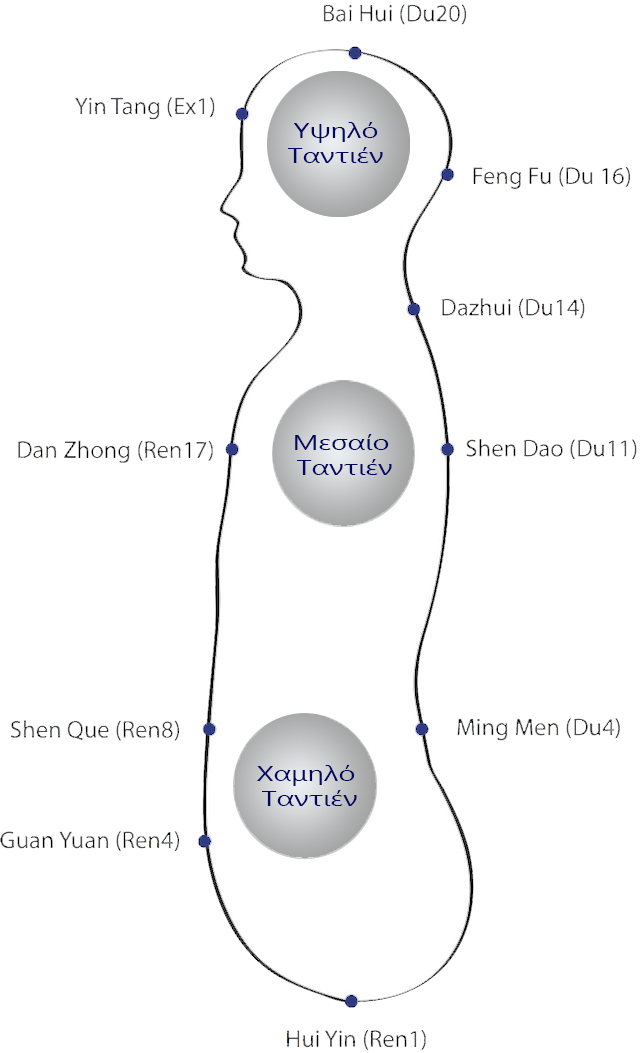
There are three primary Dantiens recognized in traditional Chinese culture: the Lower Dantien, the Middle Dantien, and the Upper Dantien. Each of these energy centers is associated with different aspects of physical, mental, and spiritual development. The three Dantian are where the Three Treasures - San Bao [Chin.: sānbǎo 三宝]: Jing - Essence [Chin.: jīng 精], Qi - Energy [Chin.: qì 气] and Shen - Spirit [Chin.: shén 神] – transmute. They are also figuratively referred to as "cauldrons" [Chin.: Dàguō 大锅] in Qigong.
Lower Dantien [Chin.: xià dāntián 下丹田]: Situated approximately two inches below the navel and at the body's center of gravity, the Lower Dantien is often regarded as the most crucial energy center. It is responsible for grounding the body and maintaining physical stability. Martial artists and practitioners of Qigong often focus on the Lower Dantien to generate and store physical power. This Dantien is closely associated with the physical body, helping to harness the body's natural energy and directing it effectively.
Middle Dantien [Chin.: zhōng dāntián 中丹田]: Located at the level of the heart, the Middle Dantien is linked to the emotions and serves as a bridge between the physical and spiritual aspects of one's being. Balancing the Middle Dantien can help regulate emotions and promote mental clarity. It is often associated with meditative practices that aim to calm the mind and find emotional balance.
Upper Dantien [Chin.: shàng dāntián 上丹田]: The Upper Dantien, positioned in the center of the forehead, is considered the "third eye" in some spiritual traditions. This energy center is thought to be the seat of spiritual insight, intuition, and wisdom. It plays a pivotal role in meditation and spiritual development, allowing individuals to connect with higher states of consciousness and awareness.
Cultivation and Balancing
Cultivating and balancing the Dantiens is a core practice in various Chinese martial arts and holistic disciplines such as Tai Chi, Qigong, and meditation. These practices aim to harmonize the body's energy, enhancing physical health, emotional well-being, and spiritual growth.
Techniques to Cultivate the Dantiens:
Breath Control [Chin.: Hūxī kòngzhì 呼吸控制]: Deep and controlled breathing exercises help to nourish the Lower Dantien with vital energy and can facilitate a sense of groundedness. Proper breathing is essential for martial arts, promoting stability and power.
Meditation [Chin.: Míngxiǎng 冥想]: Focusing on the Middle Dantien during meditation can help calm the mind, regulate emotions, and encourage mental clarity. Concentrating on the Upper Dantien is often employed in practices related to spiritual development and intuition.
Physical Movements [Chin.: Shēntǐ dòngzuò 身体动作]: Practices like Tai Chi and Qigong emphasize the Lower Dantien to improve balance and coordination. These gentle, flowing movements promote overall well-being and energy flow.
Visualizations [Chin.: Kěshìhuà 可视化]: In some practices, practitioners use visualizations to guide energy to specific Dantien centers. This technique can enhance the sense of balance and vitality.
Diet and Lifestyle [Chin.: Yǐnshí hé shēnghuó fāngshì 饮食和生活方式]: Traditional Chinese medicine also underscores the importance of a balanced diet and lifestyle in maintaining the health and vitality of the Dantiens.
The Modern Relevance of the Dantien
In recent years, the understanding of Dantiens and their significance has gained recognition in Western holistic health practices and mindfulness training. The Dantien concept aligns with the principles of mind-body connection and energy flow, which resonate with many people seeking a holistic approach to well-being.
While the Dantien's cultural and philosophical context is rooted in ancient China, its principles can be applied to modern life. Whether through martial arts, meditation, or simply as a means of promoting overall health and balance, the Dantien offers a unique perspective on the interconnectedness of the physical, emotional, and spiritual aspects of human existence.
In a world where stress and imbalance are increasingly prevalent, exploring the wisdom of the Dantien can provide valuable insights and techniques for achieving harmony and vitality in our lives. By understanding and working with the Dantiens, we can tap into the reservoir of inner energy, leading to a healthier, more balanced, and fulfilling life.
A Friendly Reminder: All content included on this site, such as text, graphics, logos, button icons, images, audio clips, and software, is the property of Hellenic Shaolin Cultural Center or its content suppliers and protected by US and International Copyright Laws. The compilation (meaning the collection, arrangement, and assembly) of all content on this site is the exclusive property of Hellenic Shaolin Cultural Center and protected by US and International Copyright Laws. Any use of the content on this site, including the reproduction, modification, distribution, transmission, reindex_usation, display, or performance, is strictly prohibited.
Nestled within the dense forests of the Song Mountain in Henan Province, China, lies a sanctuary of ancient martial arts wisdom - the Shaolin Temple. For over 1,500 years, Shaolin Kung Fu has been revered as one of the most iconic and influential martial arts disciplines in the world. Its legacy transcends physical combat, embodying a profound philosophy that intertwines mind, body, and spirit. Recognized as a UNESCO World Heritage Site in…
The Pillars of Martial Morality In the intricate world of Shaolin martial arts, where discipline and tradition interlace seamlessly, a profound concept known as Wude [Chin.: Wǔ dé 武德] stands as a guiding light. Wude, translating to martial morality, goes beyond the physical prowess of combat techniques, delving into the realms of character, virtue, and ethical conduct. This ancient philosophy is the heartbeat of Shaolin practitioners,…
Zhan Zhuang [Chin.: zhàn zhuāng 站桩], often referred to as "standing like a post" or "standing stake" in English, is an ancient Chinese practice that has been gaining recognition and popularity in recent years for its numerous physical, mental, and spiritual benefits. This seemingly simple yet profound practice is a form of Qigong, a traditional Chinese system of exercises and breathing techniques designed to promote…
Many people harbor the notion that there must be an enduring, unchanging core of personality or self to make sense of their existence and life experiences. In the face of this existential question, the teachings of Buddha shed light on a profound insight: there is no actual, permanent, or self-standing personality or self. This principle constitutes the third hallmark of existence. Were a self to truly exist independently, it should be…
When people are happy and glad, take life for granted. Whereas when they suffer, when they encounter difficulties, they seek the reason for this and the way out of their difficulty. They may wonder why some people are born in poverty and misery, while others are born in favorable conditions. Some people believe that this is due to fate, chance, or an invisible force beyond their control. They feel that they are not able to live the life they…